
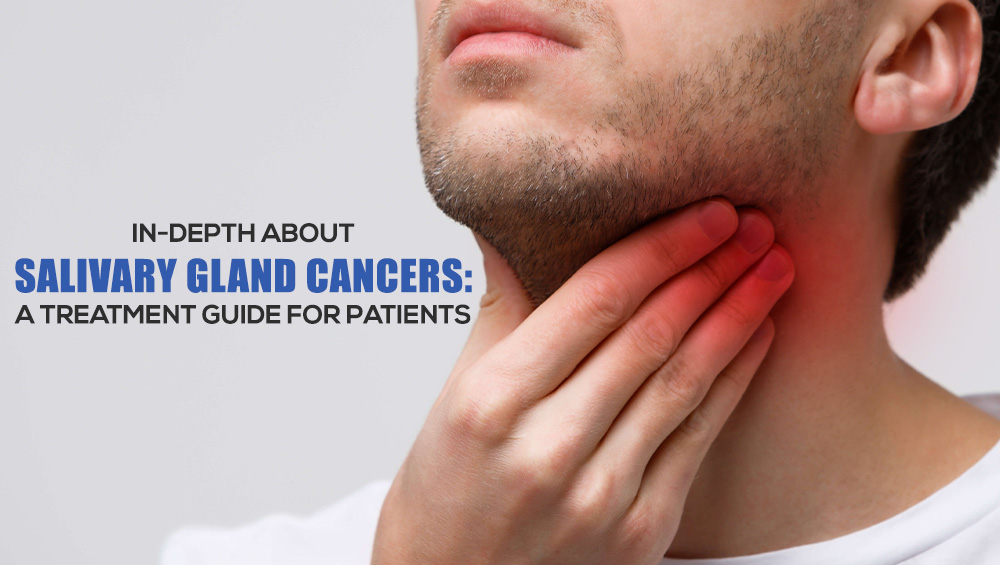
Salivary gland cancers are rare malignant tumours, accounting for less than 1% of all cancers diagnosed annually. They constitute approximately 3%–5% of all head and neck malignancies.
Types of Salivary Gland Cancers
1. Mucoepidermoid Carcinoma
Mucoepidermoid carcinoma is the most common malignant neoplasm of the salivary glands in both adults and children. It typically presents as a slow-growing, painless mass.
Key Features
- Prevalence: Approximately 30% of all malignant salivary gland tumours
- Most Common Sites:
- Parotid gland (~50%)
- Minor salivary glands of the palate (most frequent intraoral site)
- Buccal mucosa
- Submandibular gland
- Demographics:
- Affects all age groups
- Most common paediatric salivary malignancy
- Slight female predominance (female:male ≈ 3:2)
- Affects all age groups
Histological Grading
- Low-grade
- Intermediate-grade
- High-grade
Prognosis and Survival
Prognosis depends largely on histological grade and clinical stage.
- Low & Intermediate Grade:Excellent prognosis with 5-year survival rates of 97.4%–98.8%
- High Grade:Approximate 5-year survival rate of 67%, due to higher local recurrence and distant metastasis
- Paediatric Patients:Near 100% 5-year survival, as children typically present with lower-grade, localized disease
2. Adenoid Cystic Carcinoma
Adenoid cystic carcinoma is a rare, slow-growing but highly aggressive malignancy. It most commonly arises from the minor salivary glands (≈50%), but may also occur in major glands such as the parotid.
Histological Variants
- Cribriform
- Tubular
- Solid
Molecular Profile
- MYB-NFIB fusion
- NOTCH mutations:NOTCH1 mutations are associated with higher-grade disease and poorer outcomes
- Molecular Subtypes:
- Type I: MYB/MYBL1-high (better prognosis)
- Type II: MYC/NOTCH-driven (worse prognosis)
Survival Outcomes
| Metric | 5-Year | 10-Year | 15-Year |
|---|---|---|---|
| Relative Survival | 80–85% | 50–60% | 30–35% |
| Disease-Free Survival | 65% | 50% | 38% |
3. Acinic Cell Carcinoma
Acinic cell carcinoma is usually a slow-growing, low-grade tumour, most commonly affecting the parotid gland.
4. Salivary Duct Carcinoma
Salivary duct carcinoma is a highly aggressive malignancy, histologically resembling high-grade breast carcinoma.
Treatment of Salivary Gland Cancers
Surgical Management
Surgery is the primary treatment modality for most salivary gland cancers. The goal is complete tumour removal with clear margins, while preserving facial nerve function, aesthetics, and quality of life.
1. Primary Tumour Resection
Parotid Gland
- Total Parotidectomy:Gold standard for most parotid cancers, especially high-grade or deep-lobe tumours. Includes removal of intraparotid lymph nodes.
- Superficial Parotidectomy:Suitable for tumours limited to the superficial lobe.
- Radical Parotidectomy:Involves removal of the gland along with the facial nerve when the nerve is preoperatively paralyzed or directly infiltrated by tumour.
Submandibular & Sublingual Glands
- Complete excision is the gold standard
- Extended resection may be required, including adjacent soft tissue, mandible, or nerves (lingual, hypoglossal) if involved
Minor Salivary Glands
- Wide local excision, tailored to site (palate, tongue, sinuses)
2. Neck Dissection (Lymph Node Removal)
Neck dissection is performed when lymph node involvement is present or when the risk of regional spread is high.
3. Facial Nerve Reconstruction and Reanimation
The facial nerve is preserved whenever possible if it is functional and can be safely dissected from the tumour. In advanced cases, nerve sacrifice and reconstruction may be necessary.
Facial reanimation aims to restore facial symmetry, tone, and voluntary movement, with procedure selection based on duration of paralysis and muscle viability (typically within 12–18 months).
Dynamic Reanimation (Movement Restoration)
Nerve Repair and Grafting (Within 12–18 Months)
- Primary nerve repair
- Cable grafting using donor nerve
- Nerve transfers:
- Masseteric nerve transfer (gold standard for smile restoration)
- Hypoglossal nerve transfer (split technique preferred)
- Cross-facial nerve graft for spontaneous emotional smile
Functional Muscle Transfer (After 12–18 Months)
- Gracilis free flap
- Temporalis tendon transfer
Static Procedures (Symmetry and Protection)
These procedures improve resting facial symmetry and protect vital functions.
Eye Protection
- Eyelid weights (gold or platinum)
- Tarsorrhaphy / Canthoplasty
Facial Symmetry
- Static slings using fascia lata or synthetic material
- Brow lift and face lift on the paralyzed side
Adjuvant Therapy
Adjuvant radiation therapy (IMRT/IGRT) with or without chemotherapy is recommended within six weeks of surgeryfor:
- High-grade tumours
- Positive surgical margins
- Perineural invasion
This helps reduce the risk of recurrence.
Advanced Treatment Options
For advanced, recurrent, or metastatic disease, newer systemic and radiation therapies are increasingly incorporated.
Targeted Therapy
- NTRK inhibitors: Larotrectinib, Entrectinib
- HER2-targeted therapy: Trastuzumab (HER2-positive salivary duct carcinoma)
- Androgen receptor therapy: Bicalutamide
Immunotherapy
- Pembrolizumab for tumours with high tumour mutational burden (TMB-H)
Advanced Radiation Techniques
- Proton beam therapy offers superior dose distribution and reduced damage to adjacent vital structures, including the facial nerve